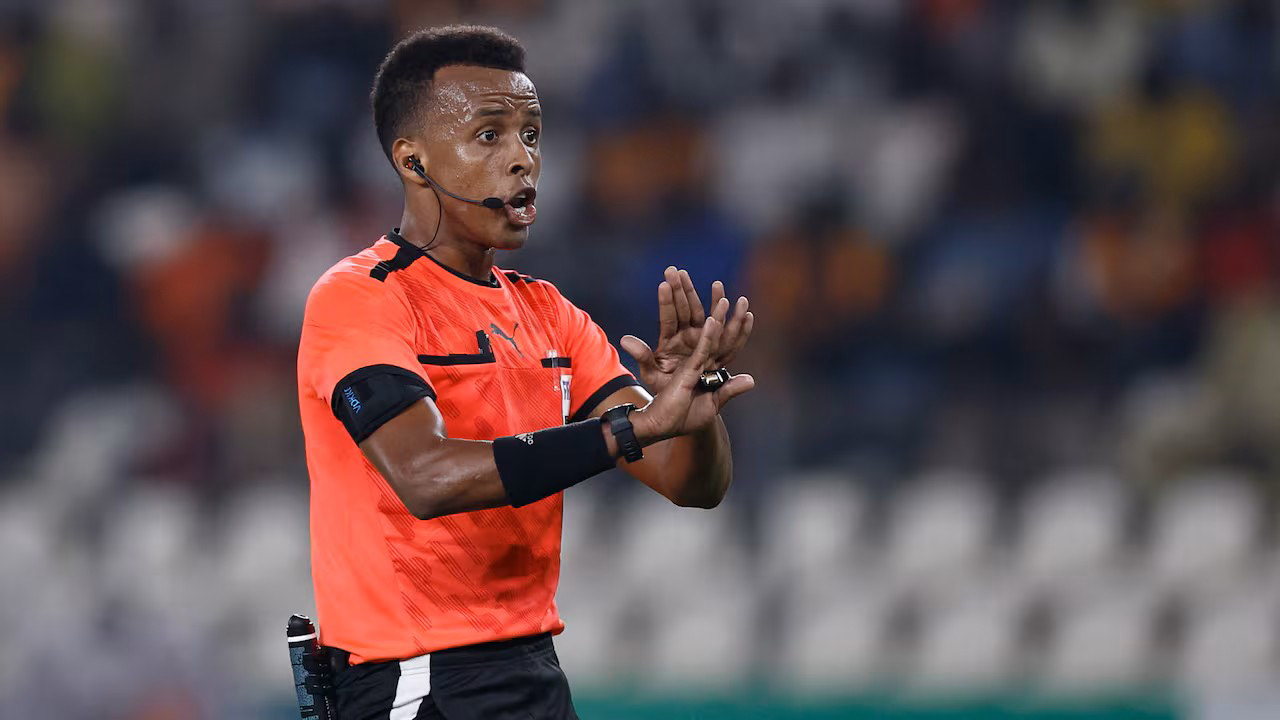
Two months ago, Omar Abdulkadir Artan was supposed to be preparing to officiate at the World Cup in the United States. He arrived with a valid visa but was denied entry, ending one of the biggest assignments of his career before he could reach the field.
On Wednesday night in Salzburg, Artan walked onto another major stage.
From a Closed Door to Salzburg
Somali referee Omar Abdulkadir Artan became the first non-European official to oversee the UEFA Super Cup when Paris Saint-Germain defeated Aston Villa 2–1 in Salzburg on Wednesday.
The achievement carried extra weight because of what happened before the World Cup. It is important to be precise: FIFA selected Artan for the tournament. He lost the opportunity because United States authorities did not allow him to enter the country.
That distinction matters. Artan had reached the required level and received the appointment. The decision at the border prevented him from completing it, but it did not erase the referee he had become.
History With Real Responsibility
The UEFA Super Cup was not simply a ceremonial appearance created for a historic first. Artan was responsible for a competitive match between two high-level teams playing for a trophy.
Khvicha Kvaratskhelia put PSG ahead before Brian Madjo equalized for Villa just before halftime. Désiré Doué then scored the winner in the 61st minute after a VAR review overturned an offside flag and confirmed the goal.
That review gave Artan’s team a meaningful decision to manage in a close match. The technology corrected the initial flag, the goal stood and the game continued without the historic appointment becoming a distraction from the football.
For a referee, that matters. A strong performance is often one in which the official remains in control without needing to become the center of the story. Artan made history while still allowing the match to belong to the players.
An African Team on a European Stage
Artan was not the only African official involved. His assistant referees were Liban Abdoulrazack Ahmed of Djibouti and Stephen Yiembe of Kenya.
Their presence made the night a wider moment of representation for African officiating, not only an individual milestone for Somalia. Three countries from the continent were represented in the core on-field team for one of UEFA’s major matches.
That visibility matters to young referees who rarely see African officials trusted on European stages. Players can point to professional pathways through clubs and national teams. Referees also need examples that show where their development can lead.
Merit, Not Sympathy
The UEFA appointment did not arrive as a sympathy gesture. Artan has been on FIFA’s international list since 2018. He became the first Somali to officiate at the Africa Cup of Nations, handled the second leg of the 2025–26 CAF Champions League final and was named the 2025 CAF Men’s Referee of the Year.
UEFA appointed him after discussions with CAF under the two confederations’ cooperation agreement. The partnership may have opened the route, but Artan’s record made him qualified to walk through it.
That is what makes Salzburg more than a feel-good ending. He did not need a replacement stage to prove he belonged. His work had already done that. What he needed was another opportunity to show it.
The Final He Still Earned
Artan did not receive the World Cup moment he had prepared for. That disappointment should not be minimized or rewritten as something that needed to happen for this later story to exist.
But in the UEFA Super Cup, he showed that a decision made at an airport did not define his standard, his career or the level African officials can reach.
The next question is no longer whether African referees can manage these stages. Artan, Ahmed and Yiembe have already answered that. The question is why opportunities like this still feel exceptional.